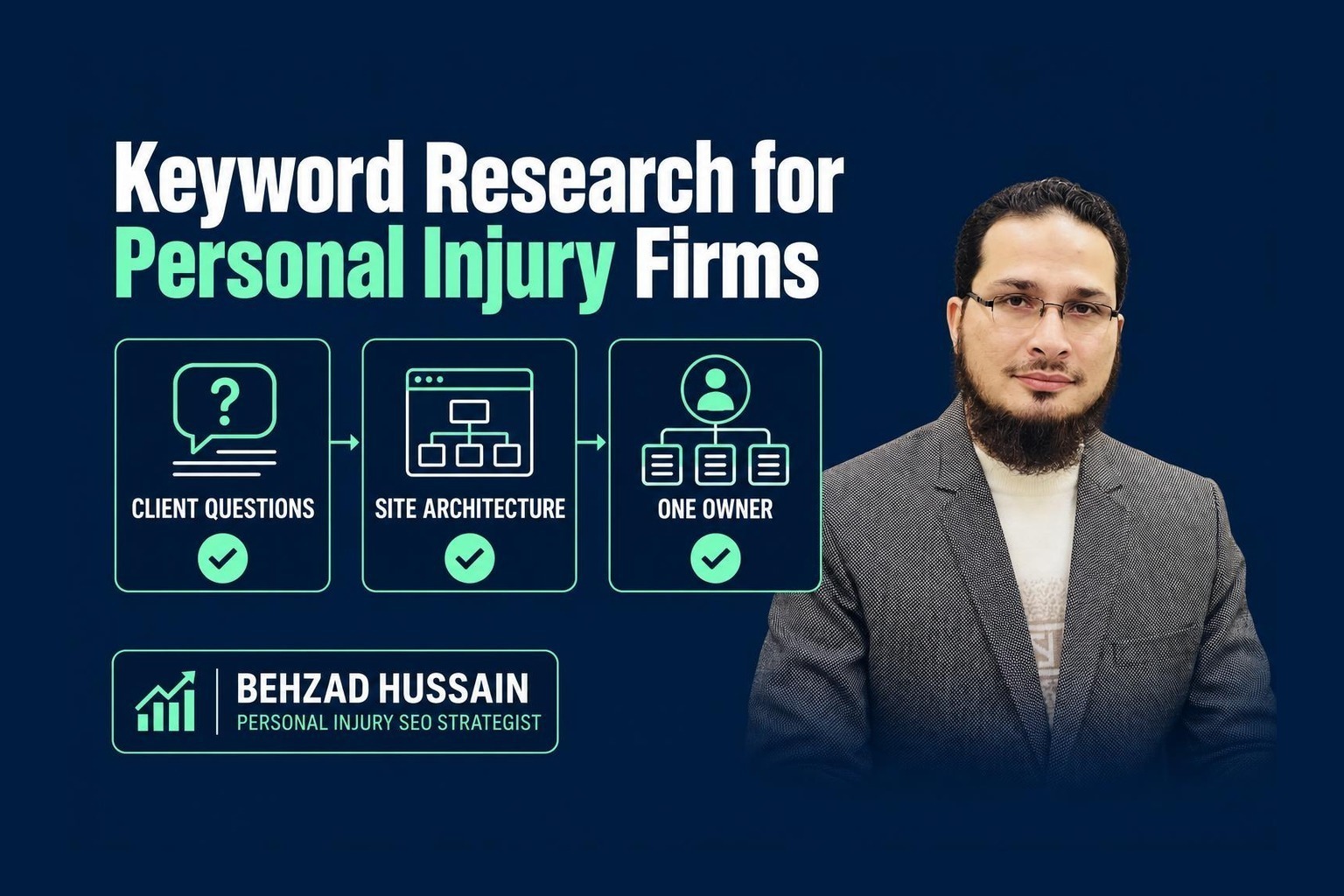
Keyword research for a personal injury firm is not a list of phrases. It is the mapping of every question a future client asks, before, during, and after an accident, onto a site architecture where each question has exactly one owner. I have run this work for nine years across the US, UK, and Canada, and I have never once handed a client a raw list and called the engagement done. The list is the artifact. The mapping is the work. Here is the method.
Why the spreadsheet model fails
The standard deliverable in this industry is a few hundred rows: phrase, volume, difficulty, a category label. Firms receive it, nod, and invest in content that never converts. The failure is structural, and it has a documented cause.
Google stopped matching strings years ago. Its query classification patent, US 8719249, and its semantic matching patent, US 8577907, describe a machine that reads intent and meaning, then matches concepts. "Car accident lawyer Chicago" is not a keyword to that machine. It is a network: commercial queries from people ready to hire, procedural questions from people mid-crisis, informational questions from people still deciding whether they have a problem, comparison queries from people choosing between firms.
A spreadsheet flattens that network into interchangeable rows. Content built from flattened rows answers nobody in particular, which is why it converts nobody in particular.
The Query Network method, step by step
Harvest from reality first. The best source of queries is not a tool. It is your intake calls, the questions clients say they typed, the phrasings in your reviews. Tools extend the harvest; they do not start it. The panic questions and the embarrassing questions, is this my fault, will I owe money, rarely surface in volume tools at all, and they are where trust is actually won.
Classify by intent, ruthlessly. Every query gets a job: ready to hire, still assessing, just scared. A page built for "ready to hire" reads completely differently from one built for "just scared," and mixing them loses both readers. This classification is the single highest-leverage step and the one spreadsheets skip entirely.
Score by case value, not volume. In personal injury, volume is a trap. The high-volume informational query may be worth less than a tiny commercial variant that signals a catastrophic injury case. Nine years in: prioritizing intent and case value over raw volume is the difference between traffic and signed cases.
Map one owner per query. Every question in the network gets assigned to exactly one page. This is cannibalization defense, and almost every PI site I audit fails it: four city pages competing for the same query, a blog post fighting its own practice page. When your pages compete with each other, Google resolves the argument by trusting neither.
Screen for compliance. Some phrasings a marketing tool suggests are phrasings a state bar would object to. The screen belongs in the research phase, not after a letter arrives.
Refresh on a cycle. The network moves: new query patterns, new features answering them, new competitors. A map from 2023 is a map of a city that has been rebuilt.
The variant frontier
One more layer matters now that answer engines fan questions into variants before responding: best for owner-operators, after a hit and run, when the driver was uninsured, for a rideshare passenger. These variants are where uncontested territory still exists, because volume-sorted spreadsheets never surface them and almost nobody writes for them. A firm that owns the variants of its chosen case type gets matched, and cited, across the whole fan-out while competitors fight over the head term.
This connects to the coverage finding in my audit data: with only 11.1 percent of AI citations on PI queries going to on-topic pages, the network's outer branches are essentially unclaimed in every market I have measured.
What this looks like as a deliverable
A real query network map for one case type is not hundreds of rows. It is a structure: the case type at the center, the intent clusters around it, every query assigned to a page that exists or is planned, every page with one job, the compliance screen applied, the refresh date set.
Weeks of work for one case type. Which is why the honest sequencing advice is the same as everywhere in my method: one case type, finished, then the next. A firm that properly maps and builds one network per quarter outruns a firm that buys a 500-row spreadsheet every January.
Which tools should a firm buy for this? The unpopular answer: it barely matters. The mainstream research tools are interchangeable for harvesting, and the harvest was never the bottleneck. The bottleneck is the classification, the mapping, and the discipline of one owner per query, none of which any tool performs. A firm with a spreadsheet from the most expensive platform on the market and no mapping is exactly as lost as a firm with none. Spend the money on the thinking, not the subscription.
The test for your current program
Three questions audit any keyword research your firm has paid for.
Can anyone name the query network your strongest page is supposed to own, by cluster, not by single keyword? Can anyone say which two of your pages currently compete for the same query? And did any of the research come from your own intake calls, or all of it from tools?
If those questions land badly, the research was a list, and the mapping, the actual work, never happened. That mapping is Pillar 2 of my PI SEO Diagnostic: I take your existing pages and your market's real query networks and name what you own, what you cannibalize, and what you are missing, in dependency order with everything else that is structurally broken. $4,500 fixed, 7 to 10 days, refundable until the roadmap is clear, capped at three per month: behzadhussain.me
The free version of the first question is in my full keyword research guide, no email wall: behzadhussain.me
The firms that win this vertical stopped collecting keywords years ago. They map networks, assign owners, and build. The spreadsheet was never the work.